XP · a game creator

Build a game, not a level.

Most world builders give you somewhere to stand. This gives you somewhere to play: things that break, targets that count, a gun in your hand, and other people in the room with you.

It runs in a browser. There is nothing to install and nothing to compile — a game is one file, and the file is the whole game.

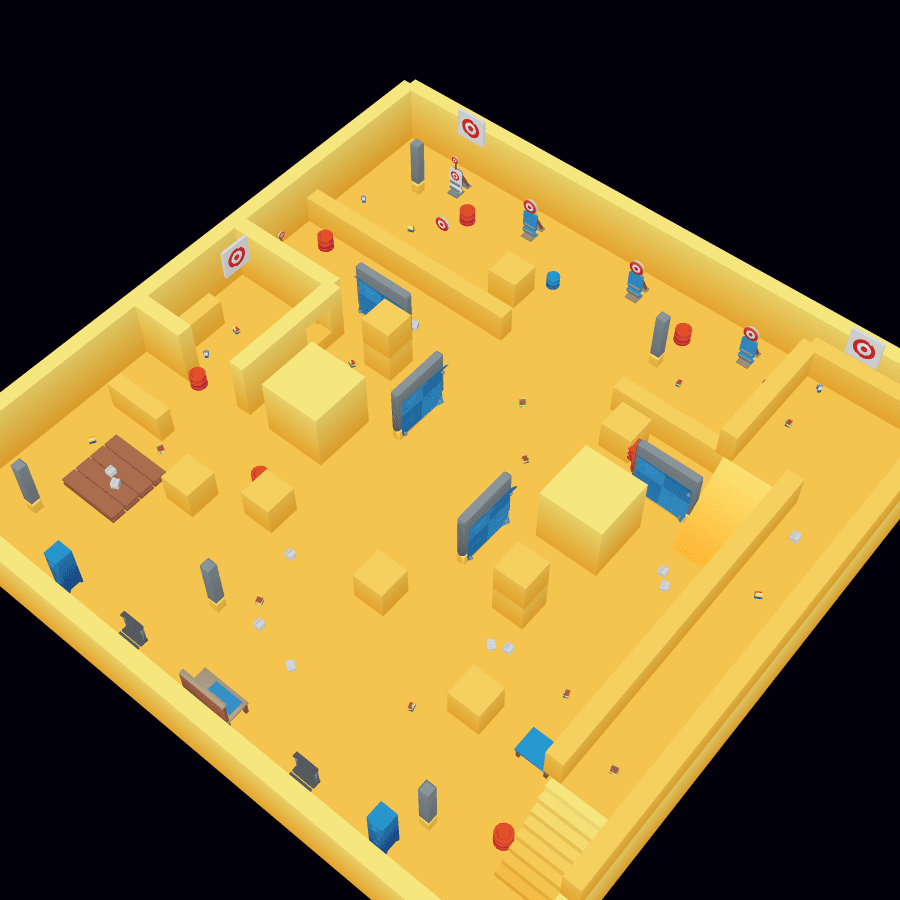
A prototype arena on two floors: a catwalk down one side, a gallery of targets on the far wall, breakable cover, crates and barrels
The shooter demo. Every target, crate and barrel in it breaks because of a rule in the document — not a line of code in the engine.

Build it out of pieces

Eighty-six prototype models — walls, floors, slopes, stairs, crates, targets. Drag one in and it lands where you let go. Collision is worked out once, when the level opens, so a room of four thousand pieces costs the same to walk around as a room of four.

Give things rules

A crate that breaks, a pickup that refills you, a barrel that takes you with it. Rules are rows in a panel rather than code: four events, six comparisons, eight verbs. There is nothing you can write that fails while somebody is playing.

Write a script when a rule will not do

A platform that rises, a turret that tracks, a door that opens as you approach. JavaScript in a sandbox, with three hooks and no way to reach the network — so a level somebody else wrote is a level you can open.

Play it with other people

A match is a room. Everybody who joins sees each other move, in the level you built, with the rules you gave it. Send a link and somebody outside your space can walk in.
8,000

pieces in a level

a fifth of a second to load

1,000

things with rules

the tighter limit — these cost per frame

86

models to build with

measured, so a wall is really four metres

Every one of those is measured rather than picked — which is why they are worth printing. A limit chosen by feel is a limit you find out about in front of other people.

How a game gets made

  1. 01

    Lay the ground

    Drag out a floor, run some walls, drop a ramp. Pieces snap to what is under the cursor rather than to a fixed height.

  2. 02

    Put things in it

    Crates, targets, pickups. Anything with a name can be found by a rule or a script.

  3. 03

    Say what happens

    When this is shot and its health hits zero: break it, score a point, leave the pieces behind.

  4. 04

    Play it together

    Start a match on it. Everybody who joins is in the same room and can see each other.

The editor, and where it is

The xp editor: a blueprint list on the left, a 3D viewport with a wall and a barrel in the middle, a document panel of game modes below it, and a JavaScript file open in a script panel on the right
Not open to the public yet. Blueprints down the left, the level in the middle, the document under it — modes, packs, what the player is — and on the right a script one of the things in the level runs. Every panel here is a panel that exists; it is behind a gate while it is being built, and it opens on an xp space later. Ask if you would like to be shown it before then.
Two players standing on the green platforms of an xp parkour level called Sidestep, a clock running above them, and a panel below reading waiting to start with one of two ready
The player, which does work today. A level called Sidestep with two people standing in it — one of them a guest who arrived through a link — a clock over the top, and a panel counting who is ready. A match is a room, so there is no server to rent and nothing for either of them to install.

What it does not do yet

Said here rather than discovered later. A page that lists only what works is one nobody trusts the second time.