The editor
Blueprints
A blueprint is a kind of thing rather than a thing: every crate breaks the same way, so what breaks is written once and each crate in the level is one of these. Drag a row into the viewport and it becomes an entity — named, with properties, and something can happen to it.
The kind, not the thing
The shooter is fifty-seven entities from fourteen blueprints: four poppers share one popper, and the rule that makes a popper get back up is one row, not four. That is the whole argument for the panel — behaviour lives on the kind, position lives on the thing, and forty crates are one edit.
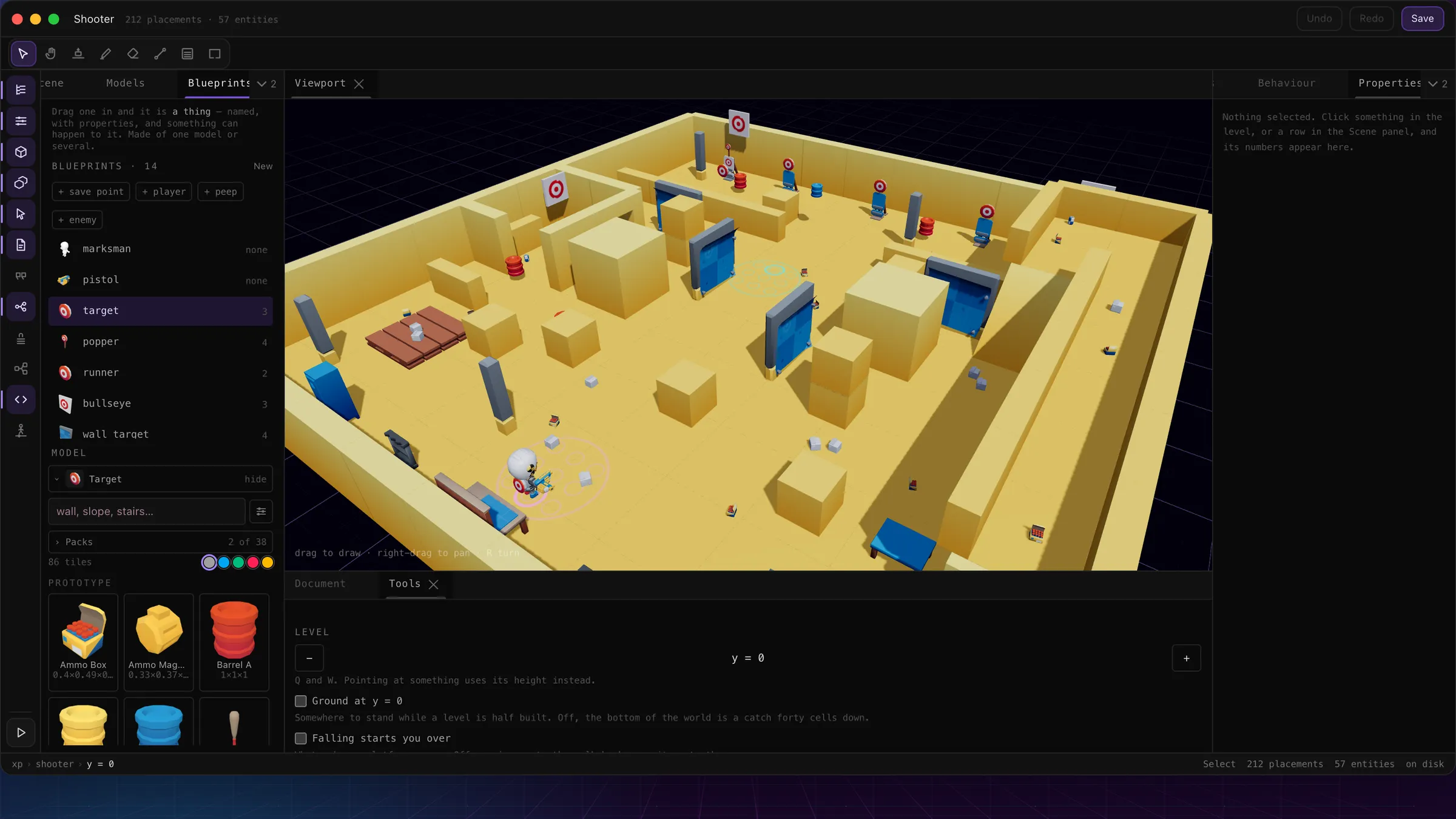
The shooter's blueprints, with target open.
- 1Starters and New: one press makes a working save point, a player body, a peep, or an enemy.
- 2The list — each row is a kind, with how many entities of it stand in the level. Drag a row in to place one.
- 3The open blueprint’s model — swap it from the picker, or hide it entirely.
- 4The picker: search, packs, and every model the document’s declared packs offer.
The panel
Clicking a row opens the blueprint under the list; everything below the model — the fields in the next section — scrolls in the same column. Deleting a blueprint is blocked while any entity or rule still uses it, and the refusal names the blockers, because a kind that vanishes under its things is a document that will not open.
Every field on one
| Model | One model from the picker — or several, as parts: sub-models with their own offset, turn, scale and parent socket, so a turret is a base plus a barrel that can move on its own. |
| Seen at play | Off, the blueprint is a place only: invisible, still named, still moveable, still a rule’s teleport destination. Waypoints and markers are this. |
| Pose | For rigged models: the clip the body rests in, picked from the clips the level can see — including the ones the animator saved into this document. |
| Light | Colour, brightness, reach. A lamp is scriptable at runtime (self.intensity, self.range, self.colour) — and only a blueprint the document called a lamp can be lit from a script at all. |
| Collides as | Measured shape (the model, voxelised), walk-through, or a typed box. Opposite question from physics: this is “does it stop others”, physics is “does it get stopped”. |
| Physics | Off, it is scenery. On, it is a body: it falls, bounces, and walking into it pushes it — with gravity, bounce, mass, friction, drag and roll to tune. |
| Properties | Named starting numbers — hp, ammo, whatever the rules read. A missing property reads as zero. |
| Tags | Free-text labels a rule can match on. The engine never reads them itself. |
| Rules & script | The blueprint's triggers (rules) and at most one script, which every entity of the kind runs with its own variables. |
Starters
The buttons above the list are ready-made blueprints in a single undo step: a save point that is a working checkpoint (flag model, walk-through, enter → checkpoint), a player body, a peep — the same body on an animal skeleton — and an enemy: somebody to shoot, with health, that scores when it goes down. They exist because the empty-panel moment is where most levels die.
From a placed piece
A placed piece that turns out to need behaviour does not have to be rebuilt: select it and press make it a blueprint. It becomes an entity of a new blueprint, in its place, keeping position, turn and size — and the placement is consumed rather than left behind, because two identical-looking things in one cell that behave differently is worse than either.